
You’ve Spent a Lifetime Saving for Retirement.
Now You Need a Strategy for Turning It Into Income.
Our Bucket Strategy helps coordinate your income, investments, taxes, and legacy goals so you can turn retirement savings into income with greater clarity and confidence.

Any of These Feel Familiar?
You don’t have to see yourself in every statement. But if a few of these describe where you are today, you are exactly the kind of person we help navigate retirement with greater clarity and confidence.
I’ve saved well, but I’m not sure how to turn it into income.
I’m within 5 to 10 years of retirement, or already retired.
I have investments, but I’m not sure I have a true retirement income strategy.
I don’t want one bad market to damage years of disciplined saving.
I want my retirement decisions coordinated instead of handled separately.
I would rather have a structured process than try to piece retirement together alone.
The goal is not just to own a portfolio.The goal is to know how that portfolio will support your retirement life.
See if a retirement income strategy session is the right next step
 The Retirement Income Challenge
The Paycheck Stops.
The Bills Don’t.
Retirement changes the question. It is no longer just, “How do we grow the money?” It becomes, “Where will income come from when markets, taxes, inflation, and life all keep moving?”
Sequence of Returns Risk
The timing of market losses matters more once withdrawals begin.
Why this matters
A major market decline early in retirement can do lasting damage if you are forced to sell investments while they are down, even if long-term average returns eventually look acceptable.
Forced Selling at the Wrong Time
Temporary declines can become permanent problems when income comes from the wrong assets.
Why this matters
Drawing income from a falling portfolio means selling more shares at lower prices. That can leave fewer dollars available to participate when markets recover.
Inflation Quietly Reduces Purchasing Power
The money you need later still has to keep up with rising costs.
Why this matters
A $5 cup of coffee today may cost much more years from now. Retirement income planning must balance near-term safety with longer-term growth potential.
The Transition Nobody Prepared You For
Building wealth and living from wealth are two different disciplines.
Why this matters
During your working years, your paycheck helped cover mistakes and market swings. In retirement, the plan itself has to replace that paycheck.
Tax Inefficiency in Distribution
How you withdraw can matter almost as much as how much you saved.
Why this matters
Retirement income can come from taxable accounts, IRAs, Roth accounts, Social Security, pensions, and other sources. The order and timing of withdrawals can affect your tax picture.
Single-Lane Financial Advice
Investment management alone may not answer the income question.
Why this matters
Retirement planning often requires investment, income, and tax decisions to work together, especially during the critical years before and after retirement.
The market doesn’t know you’re retiring. Your retirement plan should.
The Money Cycle
Most people spend decades learning how to build wealth. Very few are taught how to live from it. That's the purpose of the Money Cycle: building wealth and living from wealth follow different rules.
5–7 Years Before Retirement
Through 10 Years After

The strategy is growth.
The Climb.
Purpose of the Phase
The longest phase of the Money Cycle — typically 30 to 40 years. Save consistently. Stay invested. Let time and your next paycheck work in your favor.
During accumulation, market declines are often opportunities — your next contribution buys more shares while prices are lower.

The strategy is preservation.
The Critical Window.
Purpose of the Phase
Typically beginning 5–7 years before retirement and extending through roughly the first 10 years after retirement.
Here, a portion of your assets is positioned to help replace your paycheck — structured for stability and liquidity because they're needed first.
It's also the phase many retirement plans overlook, even though it may be the most important.

The strategy is dependable retirement income.
The Descent.
Purpose of the Phase
Your portfolio is now expected to replace your paycheck — potentially for 30 years or more.
In distribution, a market decline is no longer just a buying opportunity — there's no new paycheck arriving to buy more shares. Your investments now have a different job.
Retirement problems often begin when yesterday's accumulation strategy is used for today's income needs.
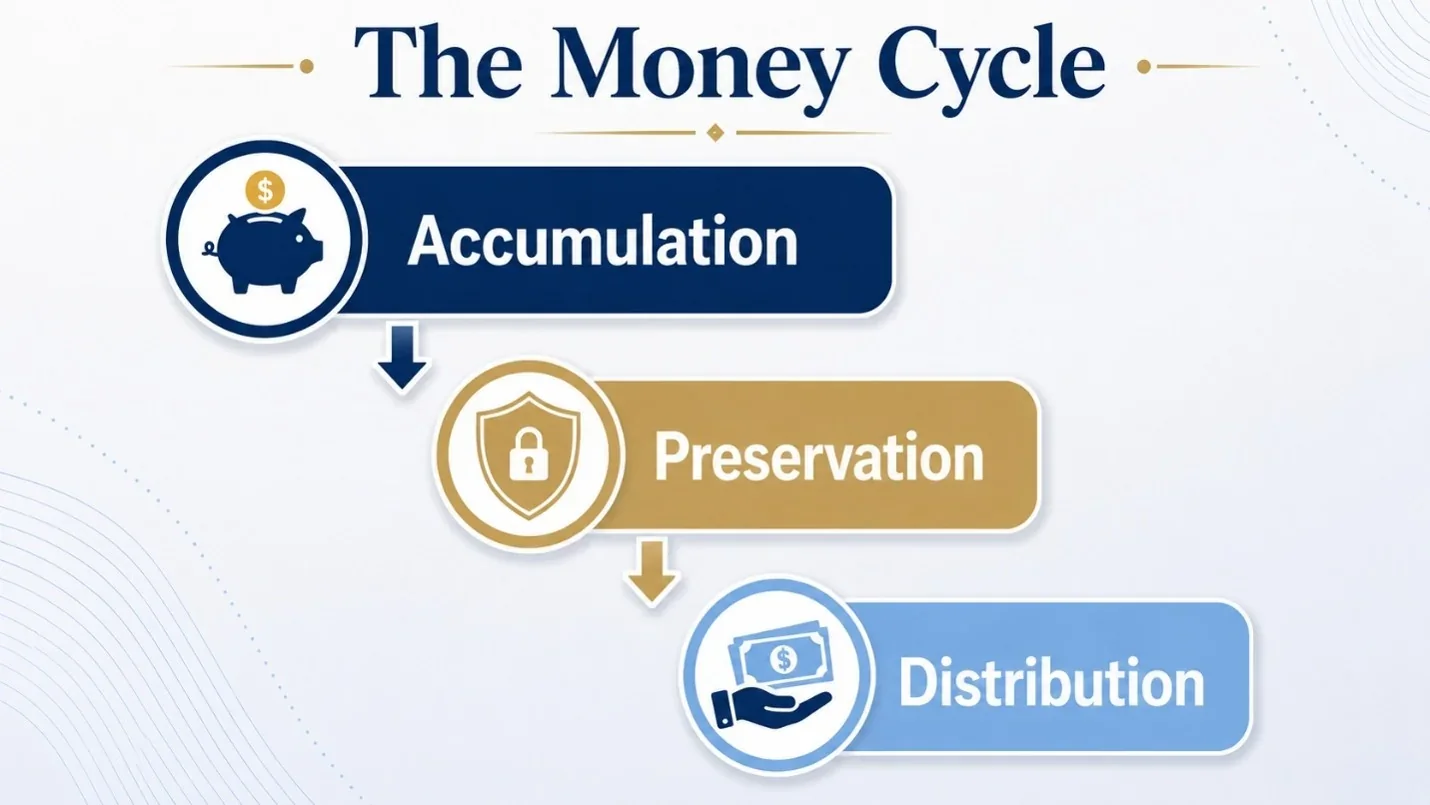
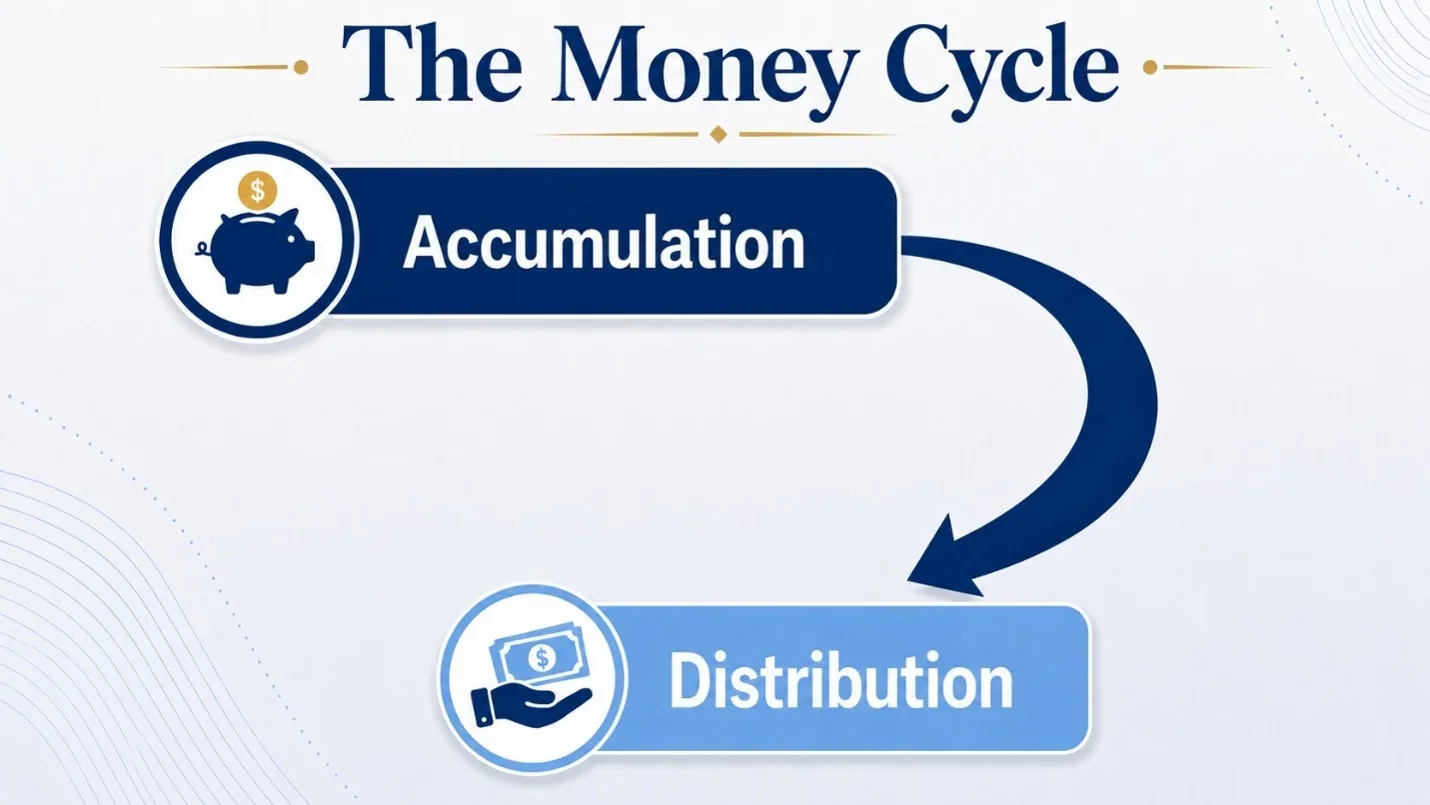
Image 2 shows what happens when the Preservation Phase is skipped entirely — the most common structural gap in retirement planning.
Is Your Advisor a Climber or a Guide for the Descent?
The financial industry was largely built to serve accumulation — its tools, products, and strategies developed for people still climbing. That's not wrong; it's simply a different specialty.
A portfolio by itself is not a retirement income plan.
It is a resource.
The accumulation and distribution portfolios may look the same. They are not. One rewards patience and growth. The other requires structure and protection. Most people are never taught the difference.
The Advisor You Needed Then May Not Be the Advisor You Need Now
If your current advisor is using the Preservation Phase of the Money Cycle — specifically addressing where your first years of retirement income will come from, how withdrawals will be sequenced, and how taxes will be coordinated — you are likely working with a Distribution Specialist.
If the conversation is still about growth, average returns, and staying invested — with no meaningful discussion of the Preservation Phase — they are likely an Accumulation Specialist. Both play an important role — the question is whether the role you need now is the one they specialize in.
The Critical Question
How will we deal with a bear market — when, not if, it happens — before or during retirement?
"The biggest mistake pre-retirees and some accumulation specialist advisors make is overlooking the Preservation Phase of the Money Cycle." — Mike F. Moss, Senior Financial Consultant
Decades of good investment advice can get you to retirement. But a portfolio alone will not get you through it. What is required is a different kind of planning entirely.
The Bucket Strategy
A Common Sense Approach to Managing Income
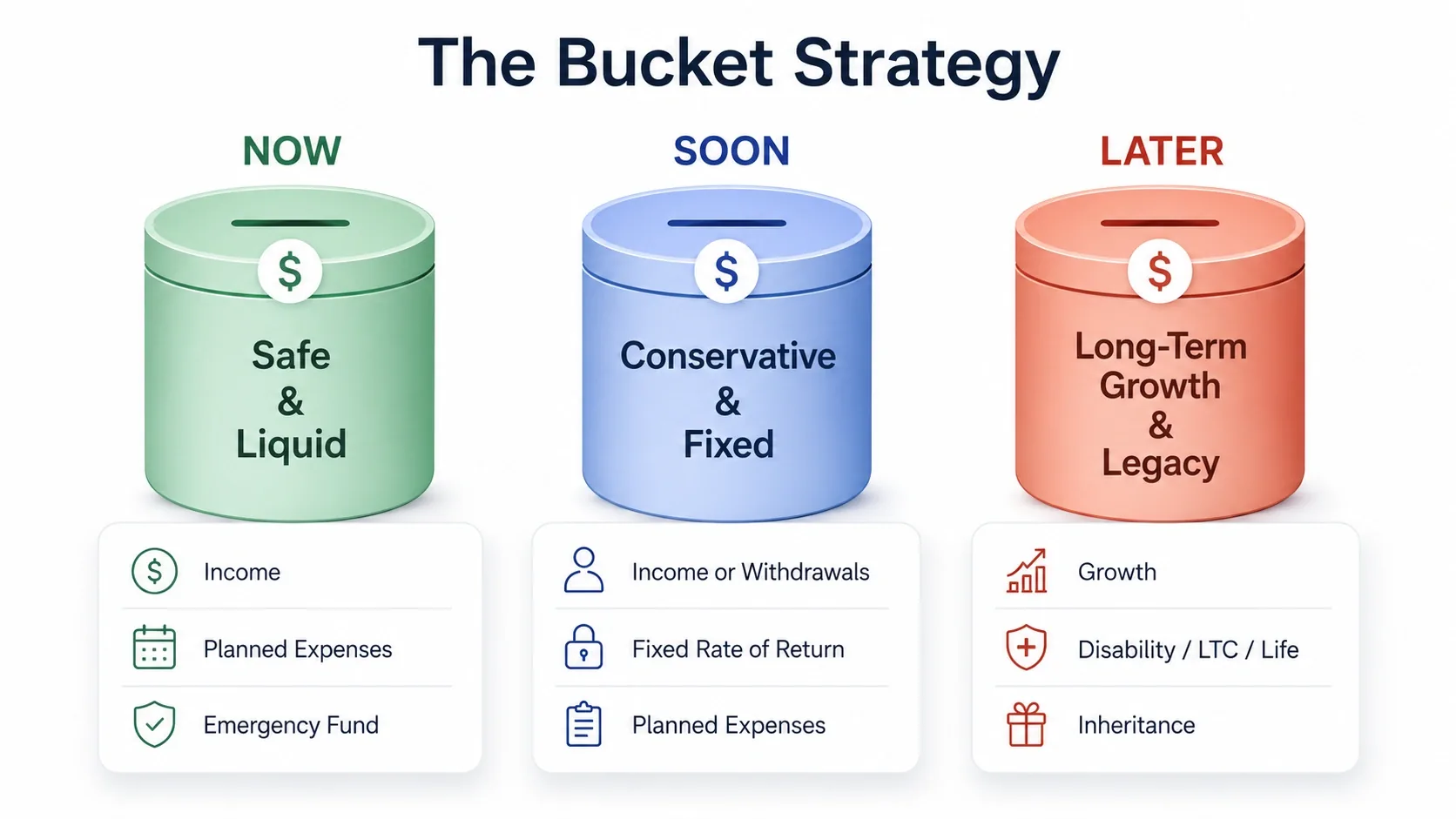
Because not every dollar should be treated the same. The Bucket Strategy simply gives every dollar the right job.

Two Risks That Shape Every Retirement Plan and a Common Gap:
The Bear Extreme
A sudden market decline can permanently damage a retirement plan when income must come from investments that are temporarily down in value.
The Inflation Extreme
Money you won't need for many years must continue to grow, because inflation quietly reduces purchasing power over time.
Different Dollars. Different Jobs.
Trying to solve both with the same dollars is one of the most common gaps in retirement planning.
Your retirement savings were built one way. Living from them requires a different strategy.
During your working years, the primary goal is accumulation. In retirement, the challenge changes. You need a strategy for turning savings into income while still giving longer-term dollars time to grow.
The Bucket Strategy organizes retirement dollars by purpose and timeline, so near-term income, future income, and long-term growth are not all forced to do the same job at the same time.
Explore the Bucket Strategy Page⚠ Hypothetical illustration only. Not representative of any actual investment or account. All investing involves risk including loss of principal.
The Beacon 360 Process
Holistic fiduciary guidance for one of life's most important financial transitions, guiding you from uncertainty to clarity and into retirement with greater confidence.

Discovery
Leads to ClarityWhat We Cover in This Phase
- Your goals, concerns & priorities
- Your current risks, finances & taxes
- Our process & planning strategy
- Our costs, services & deliverables
Design
Leads to DecisionsWhat We Cover in This Phase
- Organizing your financial life
- Understanding your net worth
- Assessing your cash flow
- Tax return analysis
- Visualize, design & develop your plan
Build
Leads to ResultsWhat We Cover in This Phase
- Finalize your custom Bucket Strategy
- Optimize your cash flow & taxes
- Align investments with your plan
- Transition & implement your plan
Protect
Leads to ConfidenceWhat We Cover in This Phase
- 45-day strategy review meeting
- Active plan & tax management
- Ongoing proactive investment & wealth management
- Plan update & strategy meetings
What to Expect at the Discovery Strategy Session
- A focused conversation about your goals, concerns, and priorities
- A plain-language overview of the Beacon 360 Process
- An honest discussion of your current risks and opportunities
- A clear explanation of our costs, services, and deliverables
- Clarity on whether there is a fit — no obligation either way
What the Process Is Designed to Coordinate
The Beacon 360 Process brings retirement income, investments, taxes, Social Security, Medicare, estate considerations, and family priorities into one coordinated plan. The goal is not just to manage investments, but to help you understand the decisions ahead and the order in which they should be addressed.
 What We Do
Three Lanes of Focus
Most financial guidance stays in a single lane. Retirement income requires all three, working in coordination.
Investment Management
Comprehensive portfolio management aligned with your Bucket Strategy — every investment decision made in context of when those dollars will actually be needed. This includes investment account management, Roth conversion analysis, and ongoing monitoring and rebalancing.
Retirement & Financial Planning
Coordinating income, Social Security, planning scenarios, and legacy decisions so the major pieces work together.
Tax Management & Distribution Planning
Distributing wealth requires fundamentally different strategies than accumulating it. Coordinating tax planning and withdrawal sequencing can affect how much retirement income you keep over time — including planning for the Widow's Tax Penalty, a reality that touches virtually every married couple in America.
Lighthouse Financial Strategies and Cambridge Investment Research do not provide tax or legal advice. Consult a qualified legal or tax professional.




Frequently Asked Questions
What happens to my income if the market drops?
The Bucket Strategy separates near-term income from growth assets, so a market decline doesn't directly impact your monthly income.
What does the Income Strategy Session phone call look like?
It is a relaxed, no-obligation 20–30 minute phone call focused on understanding your situation, your questions, and whether our planning process may be a good fit. We explain how we work, talk through your most important retirement concerns, and help you decide whether a next step makes sense.
What is the Bucket Strategy?
A time-segmented retirement income approach that organizes savings by when the money may be needed. It is designed to separate near-term income needs from longer-term growth assets.
Who is an ideal client for Lighthouse Financial Strategies?
We work best with age 50+ pre-retirees and retirees who want their major retirement decisions coordinated through one ongoing planning process.
What is the Beacon 360 Process?
Beacon 360 is our four-step planning framework: Discovery, Design, Build, and Protect. It organizes the decisions involved in creating, implementing, and maintaining your retirement plan.
Who You’re Contacting
Mike Moss
Senior Financial Consultant
Lighthouse Financial Strategies
Boardman Office
970 Windham Ct., Ste. 7
Boardman, OH 44512
Phone
330-758-7545
Primary Service Area
Boardman, Canfield, Poland, Austintown, Youngstown, Warren, the Mahoning Valley, and nearby Western Pennsylvania
Schedule Your Income Strategy Session
A relaxed, no-pressure 20–30 minute phone call to learn about your situation and see whether our retirement income planning process may fit your needs.

The life your plan is built to protect.
You do not need to have every account statement in hand or all of your financial information organized before the call. Most people come to us because several retirement decisions have started to feel connected, complicated, and too important to guess at. The first conversation is simply about understanding where you are and whether our process may be useful.
Your situation
You are age 50+, retired or within 5–10 years of retirement, and want a clearer plan for turning savings into income.
What you have
You have approximately $1 million or more in retirement savings and investable assets and want them coordinated within a broader retirement plan.
What you want
You want an ongoing planning relationship and a structured process, rather than trying to sort through complex retirement decisions by yourself.
Who It May Not Be For
You prefer to manage everything yourself with no outside guidance. You are mainly looking to actively trade or time the market. You are not yet building toward retirement.
How it works
We will ask about your situation, walk through your most pressing questions, and give you an honest picture of what working together could look like.
The goal is to identify anything that could get in the way of retiring when you want to. If I believe I can help, I’ll suggest possible next steps and leave the decision entirely up to you.
Having difficulty using the online scheduler? Call 330.758.7545 or email mike.moss@lfscompass.com to schedule your Income Strategy Session.